
About Me
Built and sold businesses in three verticals, grew accounts to $1.5M+, and am now scaling Treenia from a validated MVP to a multi-platform SaaS for >100 committed users and B2B pilots underway. As a relentless contrarian polymathic creative entrepreneur and systems-first visionary with deep domain name and social media branding portfolio expertise. I am the mission-driven founder building Treenia as the future of digital identity. Residing in Mt. Laurel, NJ, with passion and grit for building sustainable, breakthrough, and disruptive innovative startups. Transforming visionary ideas into successful ventures. As the founder of Treenia, I strive to streamline domain name search and one-click multi-platform matching social media registration for the next generation of entrepreneurs.
Great founders are able to recruit and lead a great team that believes in their mission to solve a huge problem. Learning from and navigating failures to solve it, then celebrates success together…
As a Founder:
Above all, I build cultures where grit and relentless execution are the norm, where every teammate owns accountability and the wins. It is purpose and impact that fuel us, not titles.
As CEO
- I set the vision of Treenia
- Define the “problem space” (what needs solving, why it matters, who it serves)
- Prioritize which opportunities to pursue first
- Secure talent, capital, and partnerships
- Remove roadblocks so the team can move fast
As a Mentor, I gift my knowledge and perspective to founders with no strings attached—while advising comes with responsibilities, compensation, and shared financial interests in a company’s future. Know and respect the difference.
Throughout this blog, as you scroll over text, you will find links (backlinks) to many other sites I have inserted to verify the narrative of my content. However, I am not responsible for the content, maintenance, or security of other sites. All views, content, and opinions expressed here are my own and not of any other person or entity.
Startup Achievements & Visionary Journey
I’ve built Globe Icons Creative (GIC), Inc. as an agency startup where I raised and garnered investment from Super Angel Stephen Joseph, Esq. Partnered with Ted Costa, Esq., and IP Attorney Scott Sciolli, LLP, to sell advertising space on biodegradable and compostable coffee cups distributed by coffee distributors, institutions, and QSRs.
I taught myself general computer repair and moonlighted as a web designer building websites for clients for 15+ years. AAAPCTECH (APT), LLC., a mobile computer repair service “named to be first in the phone book in Philadelphia” that my wife and I pivoted and converted into an online drop-shipping ecommerce business, that garnered large-scale residual client supply and fulfillment contracts for New Horizons Learning Centers (a global IT school) and large-scale engineering firms.
At age 18, I started Bricks N’ Mortar (BNM), as a masonry contractor, employing my friends and classmates. I am also a retired law enforcement officer.
Trenton, NJ – Early Life
Trenton wasn’t a place you grew up in so much as a place that grew up inside you.
People who didn’t live there think they understand it because they drove through once, or because they saw a headline, or because they knew someone who knew someone who moved away from it. But places like Trenton don’t translate through secondhand stories. You have to feel the weight of it pressing against your ribs. You have to taste what it’s like for life to tell you early: nothing is free, nothing is safe, nothing is guaranteed.
Where I grew up, you learned quickly that comfort wasn’t coming.
Heat didn’t always come.
Security didn’t come.
Money didn’t come.
Hell, sometimes even hope didn’t come.
But you still woke up.
You still walked out the door.
You still tried.
That’s where ganas was born for me — not from speeches, not from books, not from mentors, but from the kind of childhood where you don’t get the luxury of waiting for motivation. You move because standing still costs more.
There’s something about growing up in a place where people carry both pride and pain in the same breath. In Trenton, almost nobody got to choose who they wanted to be. Circumstance chose for you. And the first lesson you learn is this: if you don’t push back, life will make the decisions for you.
That’s where my understanding of effort began — not as a choice, but as survival.
I didn’t realize it at the time, but that environment was shaping my operating system long before I had words for it. The metaphors that would define my life — the watch that only ticks forward, the rear-view mirror rule, the wishbone and backbone — they were all seeds planted in those early years. You don’t see it while you’re living it. You see it when you look back and realize how many of your instincts were forged in places no one from the outside could understand.
Trenton taught me contradiction.
Taught me conflict.
Taught me that people can love you and still fail you.
Taught me that people can hurt you and still care for you.
Taught me that survival and pride often fight for the same space.
It gave me a childhood where I learned to read people fast.
Where I learned that silence sometimes tells you more than words.
Where I learned that trust is earned at a cost, and once you’ve earned it, you defend it.
And it taught me the most important thing I would learn early:
you are not the environment you were born into — but it will build the bones you walk life with.
Growing up there gave me grit before I knew what grit was.
It gave me fear before I understood fear.
It gave me agency before I knew the word for it.
You don’t realize that the world is bigger until you leave a place like that. But you also don’t realize how much that place prepared you for the world until life punches you later — and you find yourself standing when others fold.
Trenton didn’t give me a soft start.
It didn’t give me shortcuts.
It didn’t give me safety.
It gave me foundation.
The kind that doesn’t crack later in life when everything else does.
It gave me the ability to get back up when I shouldn’t have.
And it gave me the one lesson that has never once betrayed me:
Forward motion is the only way out.
Not because it guarantees success — but because stopping guarantees failure.
Welcome to where it starts.
The Early Lessons
Some lessons arrive loud — the kind that crack your life open and leave permanent marks.
But the early ones? They come quiet. They come disguised as ordinary days, ordinary moments, ordinary problems. And only years later do you realize those small moments were actually structural beams. They were shaping the way you think, the way you react, the way you measure yourself against the world long before you had language for any of it.
My early lessons weren’t philosophical back then. They were survival.
They weren’t stories — they were instructions.
That’s how life teaches you when you grow up without a cushion.
Lesson One: No One Is Coming.
Nobody said it out loud, but the truth showed up early.
If something broke, you fixed it.
If you wanted something, you found a way.
If you fell, you got back up.
If you cried, you wiped your own face.
People like to say, “Childhood should be innocent.”
They say that because they’re describing their childhood — not mine.
Mine was instructional.
And the first instruction was:
“You get up because you have to. Not because someone comforts you first.”
It sounds cold when you read it as an adult.
As a kid, it’s just normal.
Lesson Two: Life Doesn’t Slow Down For Your Feelings.
You don’t get the luxury of breaking down just because your world feels too heavy.
Bills don’t pause.
Responsibilities don’t pause.
People don’t pause.
So you learn early to carry more than you should.
You learn to shove emotions into the cracks of the day and deal with them later — or never.
You learn to show up even when you’re hurting.
And later in life, when people tell you, “I don’t know how you stay so calm under pressure,”
you just smile.
Because they don’t know the pressure you grew up under.
Lesson Three: Pay Attention.
When you grow up around unpredictable environments, you learn to read people — fast.
Tone of voice.
Eyes.
Hands.
Pacing.
Breathing.
Door slams.
Silence.
The world teaches you:
“Pay attention or pay the price.”
This skill becomes intuition later.
It becomes leadership later.
It becomes survival in conversations, negotiations, relationships.
But as a kid, it’s just vigilance.
Lesson Four: Wanting Isn’t Enough.
Every kid wants things.
But not every kid sees the gap between wanting and getting as clearly as I did.
You learn quickly that wishing doesn’t shorten the distance.
Only action does.
This is where the roots of my “backbone vs wishbone” philosophy came from — though at the time, I didn’t have the words. I just knew that nobody was impressed with desire. People were impressed with results.
Life had no patience for dreamers who didn’t move their feet.
Lesson Five: Time Only Moves One Direction.
The watch metaphor — my oldest and truest lesson — didn’t appear fully formed in childhood.
It started as a feeling.
The feeling that childhood wasn’t waiting for you to be ready.
The feeling that days kept coming whether you kept up or not.
The feeling that you couldn’t go back and fix something once it was done.
Time taught this lesson by moving forward while you were still learning backward.
Later in life, this would become one of my core philosophies:
You can look behind you, but you can’t walk that way.
Lesson Six: The World Won’t Always Be Fair, But You Still Have To Show Up.
A lot of kids learn fairness first.
Kids like me learn reality first.
You understand early:
- some people get breaks you never will
- some people get help you never got
- some people get comfort you never knew
And you learn not to resent it.
Not because you’re noble — but because resentment wastes time.
Showing up is the only counterweight to unfairness.
That’s when you begin to understand effort as identity.
The Truth Behind All These Lessons
No child should have to learn them this early.
But the ones who do grow into people who carry themselves differently.
Not harder.
Not colder.
Just… aware.
Aware of what life takes.
Aware of what life requires.
Aware of what life doesn’t promise.
And when adulthood finally arrives and throws its punches —
the kind that knock other people out —
you realize your early lessons were armor.
Not protection from pain,
but preparation for it…only to “remember” the famous Mike Tyson quote —
“Everybody gotta plan, till they get punched in the face!”
These early lessons shaped the part of me that never quits.
The part that keeps moving.
The part that refuses to let circumstances define the ending.
The part that later built companies from nothing.
The part that walked through failure and stayed standing.
The part that became a husband, a father, a founder — even after life tried to break me first.
Those early lessons were the blueprint.
I just didn’t know yet what they were building.
Wishbone Vs Backbone
Most people don’t realize when they’re young that life is already sorting them into two groups.
Not by wealth, not by family, not by talent — but by something deeper:
Those who want,
and those who move.
Back then, I didn’t have the words “wishbone” and “backbone.”
I didn’t know these two ideas would follow me through every part of my life — childhood, work, family, marriage, fatherhood, failures, reinvention, and eventually entrepreneurship.
But the lesson started early.
The Wishbone
The wishbone is the part of us that hopes (If I only did…What if I did…I am going to… It will happen…)
It dreams.
It imagines.
It wishes for things to get better.
It believes that good intentions count for something.
It wants life to recognize that you’re trying.
The wishbone isn’t a bad thing.
You need imagination. You need belief.
You need the ability to see the life you want.
But here’s the truth I learned early — wishbones rarely survive reality.
Reality eats wishbones.
I saw it growing up.
People who talked about what they were going to do “one day.”
People who waited for the “right time.”
People who wanted things badly but never moved differently to get them.
The world is full of people with powerful wishbones and weak outcomes.
The Backbone
The backbone is different.
Backbone is action.
Backbone is movement.
Backbone is showing up when you don’t feel like it.
Backbone is doing it scared, tired, broke, or alone.
Backbone is choosing discipline over drama, and effort over excuses.
Backbone is when your behavior finally catches up to your goals.
A backbone doesn’t hope for a better life — it builds it.
And the thing about backbone is this:
It’s not emotional.
It’s mechanical.
You move because you have to.
Not because you’re inspired.
The Moment I Learned the Difference
There wasn’t a single dramatic event that taught me this.
It was accumulation — a thousand small realizations.
Every time something didn’t go my way.
Every time I had to get back up.
Every time life handed me responsibilities I wasn’t ready for.
Every time I saw someone freeze or complain or wait for a miracle while life kept moving around them.
Backbone was built in the moments when quitting would have made sense — but I didn’t.
And eventually, I realized:
Life doesn’t reward want.
It rewards movement.
“Never let a wishbone grow where a backbone should be!”
Or it will cost you time looking in the rearview mirror, wishing you had a backbone…
Why This Lesson Matters Later in Life
As an adult, you start to see the pattern everywhere.
You see it in relationships, where people “wish” for change but never alter their behavior.
You see it in careers, where people want promotions but avoid responsibility.
You see it in fitness, where people want the outcome but hate the process.
You see it in personal growth, where people wait for motivation instead of manufacturing discipline.
You see it in business, where ideas are cheap but execution is priceless.
And you see it in yourself — in the moments when your wishbone whispers,
“Maybe tomorrow,”
and your backbone answers,
“No. Today.”
Why I Teach This Lesson to Others Now
Because I learned it the hard way.
And because most people never hear it in time.
People misunderstand success.
They think it’s luck or talent or timing.
But success — the real kind, the sustainable kind — is just backbone expressed over years.
Backbone shows up.
Backbone learns.
Backbone adapts.
Backbone keeps moving even when progress is invisible.
Backbone is ganas in motion.
The Truth Most People Don’t Want to Admit
Your life — the one you are living right now — is proof of whether you rely more on your wishbone or your backbone.
Your health shows it.
Your career shows it.
Your relationships show it.
Your bank account shows it.
Your reputation shows it.
Your peace shows it.
Your confidence shows it.
Your progress shows it.
Your backbone is visible.
Your wishbone is only audible.
People hear your hopes.
They see your effort.
And the world rewards what it sees.
The Lesson in One Sentence
Your wishbone tells the world what you want.
Your backbone tells the world who you are.
And when life tests you — really tests you — it won’t measure your dreams.
It will measure your spine.
THE MIRROR THEY BROKE TO TEACH ME HOW TO SEE
Some lessons arrive wrapped in pain.
Some arrive wrapped in fear.
And some arrive wrapped in a moment so intense that it brands itself into your nervous system for life.
This one had all three.
And it took place in a 1978 Cadillac Coupe DeVille — a car too big, too heavy, too wide, and too symbolic for the boy I was. It belonged to my Grandfather that passed in ’87, and the car I was taught how to drive in.
THE MEN WHO RAISED ME
To understand the lesson, you need to understand the men.
My real father was an alcoholic, a drug kingpin, and eventually a fugitive who died indegent on the run.
My stepfather — his best friend — was a Marine Vietnam veteran, a state worker, a man who carried discipline and pain in the same breath.
Two different men.
Two different worlds.
Both of them shaped me.
And on that day, both of them were in the Cadillac with me.
My real father in the backseat, and my stepfather riding shotgun!
THE ONE-WAY STREET
My stepfather and my father were teaching me to drive in my grandfather’s car — that enormous, floating Cadillac that felt more like steering a boat than a car.
He didn’t pick an empty parking lot.
He didn’t pick an open road.
He picked a tight one-way street off Broad Street in Trenton, with cars parked on one side with barely inches of clearance, with no sidewalk and concrete steps from homes on the other.
A place with no room for fear.
He stipped, switched, and got in the front seat.
I got behind the wheel.
The Cadillac idled beneath me like it knew something I didn’t.
“Drive,” he said.
And I tried. With the side mirror so close to other cars, you could hear it plinging off car door handles of parked cars.
But fear has a weight to it — a real physical weight — and it froze me.
My hands tightened.
My breathing shortened.
My chest locked up.
I just wanted to get out of it.
There was no way I could maneuver that behemoth through that needle hole of a street without smashing something.
I kept looking in the rear-view mirror — checking what was behind me, what was coming, what might hit me, what if they needed to get through, what I was afraid of.
That’s when he snapped.
Not out of rage.
But out of conviction.
THE KICK
He lifted his leg and kicked the rear-view mirror off the windshield.
Clean off.
The mirror swung, dropped, and hit the dash.
My fear turned into shock.
Then he got out of the car.
I sat there — heart pounding — not sure if I should move, speak, cry, or run.
He walked around, pulled off his shirt and told me to take mine off, and tied it over the side mirrors, covering them completely.
Then he got back in and said:
“Pick your head up.”
I looked at him.
He pointed down the road, to the very end of that impossible one-way stretch.
“Look there.
Focus there. Know what is around you.
Focus on what you are doing, and where you are going.
Not what’s behind you.”
I stayed frozen.
He wasn’t finished.
THE LESSON
“If anyone hits you from behind, they hit you” he said,
“it’s their fault.
But if you hit anything in front of you…
that’s on you, and it’s you’re fault!”
Then he leaned in.
“Stop looking back.
Stop checking what’s creeping up behind you.
Stop worrying about what already happened.
All that matters is what’s ahead of you.
Keep your eyes forward and find your way through. Now Move!”
He didn’t say it gently.
He said it like a Marine.
He said it like a man who’d seen enough life to know the truth:
Fear makes you crash more than obstacles do.
Looking backward makes you lose control.
So I lifted my chin.
Put my hands back on the wheel.
Focused on the end of the street.
And I drove that Cadillac through a space that shouldn’t have been drive-able like it was meant to be.
Not because I wasn’t scared anymore.
But because the lesson was bigger than the fear.
WHAT I DIDN’T UNDERSTAND UNTIL YEARS LATER
That moment wasn’t about mirrors or cars or streets.
It was about life.
It was about forward motion, accountability, and direction.
It was about learning:
- the past can’t steer you
- fear can’t save you
- the unknown ahead is the only thing you can influence
- the only collision that counts is the one you cause
- forward has consequences you can control
- backward has history, and ghosts you can’t change, or talk with… Only “remember”.
And the strangest irony of all is this:
Two men who lived their lives with chaos…
taught me the discipline that shaped mine.
They lived looking backward.
They lived haunted.
They lived chased by mistakes.
But the lesson they gave me taught me how to live differently:
**Forward is the only direction with possibility.
Backward is only information.**
THE RULE I TOOK WITH ME FOR LIFE
The mirror they broke off the windshield became a principle I built my life on:
Look back only long enough to understand.
Never long enough to drive.
And that day — scared, sweating, shaking, surrounded by parked cars —
I learned how to steer my life the same way I steered that Cadillac:
Eyes forward.
Hands steady.
Responsibility owned.
Fear acknowledged but not obeyed.
Past noted but not followed.
A boy learned to drive.
A man learned to live.
THE WATCH THAT ONLY TICKS FORWARD
Time teaches you different lessons depending on the men who show up in your life.
Some men teach through chaos.
Some teach through discipline.
Some teach through success.
Some teach through example.
Some teach through mistakes.
And a few — very few — teach through clarity.
The watch metaphor that defines my life didn’t come from one man.
It came from all of them, stitched together:
- my father
- my stepfather
- and Michael Culliney
Three men.
Three worlds.
Three lessons.
One philosophy.
Forward.
THE FIRST LESSON: THE MIRROR (DIRECTION)
My stepfather taught me what it meant to look ahead.
In my grandfather’s 1978 Cadillac Coupe DeVille, on a tight one-way street in Trenton, he kicked the rear-view mirror off the windshield when fear froze me.
Glass everywhere.
My heart in my throat.
He tied his shirt over the side mirror and said:
“Pick your head up.
Look down the road.
If they hit you from behind, it’s their fault.
If you hit something in front of you, it’s yours.
Stop living behind you.
Drive where you’re going.”
That day, he didn’t just teach me how to drive a car.
He taught me how to drive my life.
I learned:
The past is reference.
Forward is responsibility.
But the watch metaphor wasn’t born yet.
Not until Michael Culliney.
THE SECOND LESSON: THE OMEGA (IDENTITY)
In 2003, I met Michael Culliney in Myrtle Beach on a family vacation.
He wasn’t just successful — he was operationally successful.
The kind who built empires with discipline, not ego.
He had been:
- VP of Sales & Marketing at Unilever
- The man who bought SlimFast after the PowerBar lawsuit
- The one who got SlimFast into Walmart in 30 days
- The creator of Muscle Milk
- The builder of Alex’s Lemonade Stand
- The guy who bought all nine flavors of Jolly Rancher to create the beverage line
He had money.
He had power.
He had track record.
And he had nothing to prove.
One day, riding back from the Run To The Sun car show, I asked him a question only a young, inexperienced, government-salaried kid would ask:
“Mike… you’re filthy rich.
Why do you only wear an OMEGA and blue jeans?”
He laughed.
Then he said the line that changed my life:
“Ronald, I am a salesman, I wear an OMEGA to stay humble.
In some countries, people don’t have cars like this one.
They judge you by your watch, your shoes, your clothes.
If I walk into a meeting wearing a ROLEX and the man I need to do business with is wearing a TIMEX, I offend him.
I need people to buy my products.
I don’t insult the poor.
That’s why I’m wealthy.”
Then he pointed at his wrist.
“An OMEGA is the middle of the road, it means I respect myself — but I also respect them.
It tells them I’m not here to show off.
I’m here to do business.”
Later, he took that Omega off his own wrist…
and gave it to me.
I’ve worn it ever since.
Not as jewelry —
as a handcuff to humility.
Mike taught me that entrepreneurs are not hustlers.
Hustlers sell you something once.
Entrepreneurs build trust, reputation, and brand through humility and respect.
He said:
“Your reputation is your business model.
Your humility is your currency.
Your watch is a message.”
That was the day I learned the second part of the lesson:
How you present yourself determines who will follow you.
But the metaphor wasn’t complete yet.
THE THIRD LESSON: THE WATCH ITSELF (TIME)
Years later, after failures, reinventions, and rebuilding myself, I looked down at that Omega and realized something:
A watch only ticks in one direction.
Forward.
You can force it backward with your fingers,
but even then — the mechanism resists it.
It’s not built for reverse.
Neither are we.
The Cadillac taught me direction.
Mike taught me identity.
The watch taught me time.
And the three became one truth:
Forward motion is the only motion that creates possibility.
Looking backward creates:
- fear
- comparison
- shame
- paralysis
- distraction
Looking forward creates:
- responsibility
- clarity
- humility
- opportunity
- momentum
A watch doesn’t erase yesterday —
it simply keeps today going.
So should we.
THE FULL LESSON (THE COMPLETED PHILOSOPHY)
When my stepfather broke the mirror, I learned to stop driving by what was behind me.
When Mike handed me his Omega, I learned to stop branding myself by arrogance.
When life broke me, I learned to stop measuring myself by the past.
Everything pointed to the same truth:
**You don’t move forward because it’s easy.
You move forward because it’s the only direction with a future.**
And the watch — the same one Mike wore — reminds me every day:
- stay humble
- stay respectful
- stay forward
- stay teachable
- stay moving
- stay accountable
- stay watchful in the right direction
Because time doesn’t go backward —
and neither should you.
The Bedroom Floor Moment
There are moments in life that don’t announce themselves.
They don’t warn you.
They don’t prepare you.
They don’t give you a soft landing.
They hit you like truth dropped from a height.
My bedroom floor moment was like that.
It wasn’t dramatic from the outside.
There were no flashing lights.
No witnesses.
No heroic music.
It was quiet — painfully quiet — the kind of quiet that exposes everything you’ve been avoiding.
This was the day I collapsed, both physically and emotionally, under the weight of everything I had been trying to carry and control.
THE BREAKING POINT
Life doesn’t break you all at once.
It breaks you slowly — disappointment by disappointment, failure by failure, bill by bill, consequence by consequence — until the final crack shows up in a moment small enough that no one else would understand why it shattered you.
For me, that crack arrived on an ordinary day.
My health was deteriorating.
My finances were collapsing.
My marriage was strained.
My confidence was gone.
My identity was slipping.
My plans had fallen apart.
My strength was exhausted.
My fear was louder than my hope.
There comes a moment when the weight becomes too much to hold up.
You don’t choose the collapse — the collapse chooses you.
And one day, I just… went down.
All the way down.
Down to the bedroom floor.
Down to the carpet.
Down to the version of myself I had been too proud to face.
I wasn’t crying.
I wasn’t praying.
I wasn’t talking.
I wasn’t moving.
I was just… done.
WHAT HIT ME ON THAT FLOOR
People think rock bottom is a place.
It isn’t.
It’s a moment.
A clarity.
A confrontation.
Laying there, staring at nothing, I realized something terrifying:
No one is coming.
No one is saving you.
No one is fixing this.
No one is responsible but you.
And the second truth — the one that hurt worse — came right after:
You did this.
Your decisions.
Your habits.
Your pain.
Your denial.
Your fear.
Your ego.
Your shortcuts.
Your avoidance.
Your wishbone where your backbone should have been.
That moment stripped away every excuse I had ever rehearsed.
It left me naked with the truth.
THE DECISION MADE ON THE CARPET
There is a strange peace that comes when you finally stop lying to yourself.
The collapse becomes clarity.
I laid there long enough for the fear to burn out.
Long enough for the shame to loosen its grip.
Long enough for the noise to die down.
And in that quiet — the same quiet that scared me minutes earlier — something shifted.
Not strength.
Not motivation.
Not confidence.
Just resolve.
A simple, final resolve:
If I stay down, I lose everything.
If I get up, I’ve lost nothing yet.
Forward motion wasn’t a philosophy in that moment — it was survival.
So I pulled myself off the floor.
Not gracefully.
Not confidently.
Not bravely.
Just… intentionally.
THE FIRST STEP BACK UP
People imagine that what happens next is some triumphant turnaround.
But when you break, the comeback doesn’t look like glory.
It looks like:
- showering even when you don’t care
- eating because you have to
- making one phone call
- paying one bill
- cleaning one corner
- apologizing once
- trying once
- showing up once
It looks like small decisions that feel insignificant but rebuild the structure of who you are.
For me, the first real step was this:
I stopped asking, “Why is this happening to me?”
And started asking, “What do I need to do next?”
That shift saved my life.
THE MOMENT’S MEANING
That bedroom floor moment didn’t make me a better man.
It made me an honest one.
It taught me:
- strength isn’t the ability to avoid collapse
- dignity is getting up after it
- integrity is admitting the truth
- responsibility is accepting the consequences
- backbone is built, not inherited
- forward motion is chosen, not gifted
Everything I became after that moment —
a husband, a father, a leader, a founder —
started in that room, on that carpet,
when I had nothing left to give but the decision to stand.
THE LINE THAT DEFINES THE MOMENT
You don’t rise because you’re strong.
You rise because you’ve finally decided not to stay broken.
Warming Cabs In Winter
People look at the man you become, not the roads you walked to get there.
They see the confidence — not the cost.
The leadership — not the loneliness.
The vision — not the nights you spent freezing, broke, working jobs that no one dreams about.
“Warming the cab in the winter” is one of those stories.
It was never glamorous.
Never heroic.
Never something you brag about.
But it was one of the experiences that shaped my discipline and my dignity more than anything that came later.
It was survival dressed up as a job.
THE JOB MOST PEOPLE NEVER THINK ABOUT
When you grow up without money, you don’t get to wait for the perfect job.
You take the job that exists — the one that keeps the lights on, keeps the roof over your head, keeps you from drowning.
And one of those jobs, for me, was simple:
warming the cabs in the winter.
It sounds small.
It sounds forgettable.
It sounds like nothing.
But nothing is ever “nothing” when you’re surviving.
The job was exactly what it sounds like:
You’d go to the taxi station early in the morning —
before sunrise,
before the neighborhood was awake,
before your body had caught up to your head —
and you’d get inside a freezing cold cab.
Freezing isn’t even the right word.
It was piercing.
The kind of cold that makes your hands stop working,
your face burn,
your jaw clench,
your bones stiffen.
You’d turn on the engine.
Crank the heat.
Sit there — shivering, alone, waiting —
until the car warmed enough that the actual driver could get in and see through the windows and start his shift in comfort.
That was the job.
Not glamorous.
Not impressive.
Not anything you’d tell a stranger you were proud of.
But it was honest work.
Hard work.
Necessary work.
And it taught me something I couldn’t have learned any other way.
WHAT THE WORK FELT LIKE
You learn a lot about yourself when you’re alone in a cold car in the dark.
You learn:
- patience
- pain tolerance
- discipline
- humility
- the value of showing up
- the difference between wanting and needing
- the cost of survival
- the quiet dignity of unrecognized effort
And you learn what it feels like to do work that no one thanks you for.
The cab drivers didn’t thank you.
The company didn’t thank you.
The world certainly didn’t thank you.
You were invisible.
A ghost making someone else’s day easier.
THE METAPHOR THAT EMERGED LATER
Years later — long after I had left those jobs behind — I realized the deeper meaning.
Warming the cab wasn’t just a job.
It was a metaphor for every stage of my life that required me to prepare conditions that benefited others more than myself.
Entrepreneurship felt the same way.
Leadership felt the same way.
Fatherhood definitely felt the same way.
You spend years doing work behind the scenes —
the invisible work,
the early work,
the foundational work —
so others can sit in a warm cab later and do their part.
That job taught me:
Success is built in the cold,
long before anyone sees the heat.
THE MOMENT THAT MADE IT A LESSON
One morning, sitting there shaking, teeth chattering, watching my breath fog up the windshield, I asked myself:
“Is this what my life is going to be?”
It wasn’t self-pity.
It was clarity.
It was the first spark of wanting more —
not out of greed,
not out of ego,
but out of a refusal to remain stuck.
You don’t become ambitious because you want to be rich.
You become ambitious because you’re tired of freezing.
That morning, I made a promise:
I will never live a life where I’m warming the world for other people while I stay cold.
One day, I will build the cab.
One day, I will own the cab company.
One day, I will control the heat.
I didn’t know how.
I didn’t know when.
I didn’t know what it would take.
But I knew this:
Forward motion is the only way out.
The cab was the coldest job I ever had —
but it lit the fire that carried me the rest of my life.
THE LESSON THAT STUCK
People see the entrepreneur version of me now and think confidence came first.
Confidence didn’t come first.
Cold came first.
The cold builds you.
The cold humbles you.
The cold clarifies you.
The cold teaches you:
- you can endure more than you think
- no one is coming to warm the cab for you
- your life will only change when you decide it must
- nothing grows where comfort lives
- discomfort is the birthplace of direction
Forward motion started in a freezing taxi.
With a kid whose body was shaking but whose mind was waking up.
That job didn’t define me —
but it shaped me.
And the day I outgrew that job,
I carried the lesson with me:
Every warm seat in life is paid for by someone who sat in the cold first.
WHEN DIGNITY COST MORE THAN MONEY
There are moments in life that don’t change your circumstances —
they change you.
Moments where you realize the price of dignity is higher than any paycheck,
and the cost of compromising yourself is higher than poverty.
This chapter isn’t about financial struggle.
It’s about moral struggle —
the kind that shapes the spine you carry into adulthood.
The kind you don’t forget.
THE SITUATION
There’s a point in every young man’s life where he learns exactly who he is.
Not by what he achieves,
not by what he earns,
but by what he refuses.
For me, that point came when I was offered money — good money —
to disrespect myself.
Not physically.
Not violently.
But personally.
A type of insult disguised as opportunity.
Someone dangled money in front of me
for work that was beneath the dignity I was fighting to build.
They expected me to take it because:
- I needed the money
- I came from nothing
- I was young
- I “should be grateful”
- I didn’t know better
- They thought I didn’t have a backbone yet
They were wrong.
People who grow up in scarcity are often assumed to have no boundaries.
But sometimes it’s the ones who’ve had the least
who guard their dignity the most fiercely.
I needed money — badly.
But I needed self-respect more.
THE INTERNAL FIGHT
You don’t just say “no” easily when you’re broke.
When you’re broke, your brain becomes a calculator:
- rent
- food
- gas
- debt
- obligations
- fear
- survival
A broke man has a thousand reasons to say “yes.”
But a man who’s trying to build himself has one reason to say “no.”
And that reason is identity.
I remember feeling the tension — like standing at a crossroads where both roads hurt.
One road leads to money but emptiness.
The other leads to hunger but dignity.
And I realized something:
If you sell your dignity once,
you’ll sell it again.
And eventually, you’ll forget the exact moment you lost yourself.
That terrified me more than poverty ever could.
THE DECISION
So I refused.
Not loudly.
Not dramatically.
Not with anger or ego or pride.
Just… calmly.
A simple, firm “No.
That is not who I am.”
I walked away with nothing in my pocket
but everything intact in my chest.
On paper, I lost money.
In reality, I gained something no one can buy:
the right to look myself in the mirror without flinching.
That is wealth most people don’t understand.
THE AFTERMATH
The world didn’t reward me for that decision.
Not immediately.
I didn’t walk outside and find a miracle opportunity.
I didn’t stumble into success.
I didn’t get rescued by fate.
Life didn’t clap for me.
Life didn’t congratulate me.
Life simply watched.
Because dignity doesn’t pay out in applause.
It pays out in direction.
The decision didn’t change my situation —
it changed my trajectory.
That one moment built the foundation for:
- my leadership
- my entrepreneurship
- my marriage
- my fatherhood
- my self-respect
- my standards
- my brand
- my boundaries
- my future
When you choose dignity over money,
you plant a seed that grows into a life you can live with.
THE LESSON
That day I learned:
Money solves problems.
Dignity prevents them.
There are things in life you can get back:
- money
- opportunities
- material possessions
But once you lose your dignity,
you spend the rest of your life trying to buy it back with the wrong currency.
And most men never do.
I didn’t get richer that day.
I didn’t get safer.
I didn’t get more comfortable.
But I became a man.
Because sometimes:
Your first real paycheck
is the one you refuse.
TRUST
Trust is built over time… And building a team to debate, discuss, and refine ideas into an actual product is the hardest hurdle. A startup is engineered and built together as a team with as much attention to detail as its product. To do it, I attribute and draw from concepts, principles, and skill sets I have adopted and learned growing up around my grandparents’ seven brick-and-mortar ventures they managed “all at the same time” in and around Trenton, NJ (“Educo” financial education that is not taught in schools).
They were majority stakeholders in Yellow Cab, Inc. on Barlow Circle and E. State Street. As a tween I was hired by my grandfather for $1.00 a day to perform maintenance checks of oil and tire pressure on cabs. I noticed the same man parked his car in front of the cab garage door every night, even though there was nothing wrong with the cab. Each day, I’d show up for work in the morning and have to move the same cab to move other cabs into the garage that needed service. I figured out the same “cabby” was making me warm up his cab in the morning, so he… the cab driver could be the first cab to drive out of the lot – to be the first cab in line at Trenton train station to get the first fare.
Spotting opportunity as an entrepreneur, I made my first sign and advertised “Cab Warm-ups for $1.00” as a service. Soon I had 30+ cabs a day to start and warm up every morning before school. I also became the garage manager at 18, after my grandfather passed, till its acquisition at age 23… They also owned and were partners in Hamilton Roller Skating Rink, Inc. on Youngs Rd; The Granada Bar & Restaurant, Night Club, Inc. on Whitehorse Ave.; Olden Brake & Tire; Clinton Transmission; Genesee Ceramics; and Fred’s Diner on Chambers St.

A Lesson Taught By My Grandfather About Money, Startups, Opportunity, and Business
I do not work for money; money works for me! This statement may seem bold and ambiguous; it’s not. It comes from financial “educo,” based on the principal philosophy of an American penny not taught in schools. My grandparents taught me this as the “value of a small coin.” To build a business and generate money from assets for wealth, you must know the financial language of all the people and where their money comes from as a trust over time. This is also a network of knowledge and talent. My grandparents engrained this into me consistently. The left side as an intrapreneur working for a paycheck, or the right side as a capitalist entrepreneur for financial freedom. Learning this gave me the ability to understand what each side wants and the language people on both sides use and speak to generate money. It is a methodical way to organize and categorize people. How we communicate with them and intelligently direct common-sense ideas through uncommon thinking based on trust—that is how wealth and power are merely transferred… Opportunity is created, and it comes from debt! Businesses and brands are developed based on this trust over time, gained by holding trade secrets and the know-how learned through failure, to see and capitalize on opportunity. It is not seized or invented but created.
Financial Freedom
They also taught me that to have financial freedom, you must create a business without fear of partners. The partner(s) must contribute OPT (“other people’s time”) to create the business and be held accountable for their work. All business is based on partnerships—something the average employees and solo small business (S) entrepreneurs (who are both on the right side of the coin), such as dentists or lawyers who cannot take a day off or ever leave a business (who crave the financial freedom of a big business as seen on the left side of the coin), struggle with out of “FEAR” … Fear of partnership with others and failure to create trust with others over time. Common sense tells you… Business assets generate cash flow for you; they put money in your hand, and liabilities take money out of your hand. Yet, due to people not having “financial educo,” financial education not being taught in schools, they fail miserably and believe this is what investment is.
Trust is what you rely on, generated from revenue that supports the owner(s)’ income… And what a partner must have in all of (the owner’s) to do the right thing to sustain it… Trust is also in good faith, needed to raise capital (debt) from investors, or “OPM Other People’s Money,” to scale the business. It may also be necessary to build and fund a “C” corporation business supported by cash flow that will eventually be an asset and no longer need its original founder or co-founders to manage. In fact, they were able to hire others, train management, leave for a year, and return to find it running better than the way it was when they left. Ultimately, paying themselves and the investors in that trust… a passive income in perpetuity for their contribution of OPT and OPM. It begins by knowing and believing in the founder’s vision and confidence in their resilience to recruit and bring together all of the elements necessary to manifest the business to begin with.
My journey in business began by always being curious, learning from industry-leading mentors like Michael Culliney, VP of Unilever, who inspired and taught me how to sell by watching him close the acquisition of SlimFast over a cell-phone call. While researching and developing a mobile interactive SMS marketing program. I was also introduced to and mentored by Robert Shalayda, VP of NOKIA, who gave me his copy of “Venture Deals” to read and opine on while working through FP&A modeling and negotiating tactics. Robert is now a partner of Wharton Business Valuations. I also learned from resources at YC Startup School, Microsoft Training, and being an avid reader. Leveraging partnerships and funding to scale fast while learning from my own failures (many) and working with and through entrepreneurs and founders of startups I’ve mentored. As the best way to learn how to do something is to do it and teach it. As an avid reader, I also apply knowledge and ethos gained from thought leaders such as Eric Ries, Al Ries, Steven Blank, David S. Rose (a VC I once pitched), Esther Dyson, Ash Maurya, Paul Graham, Peter Thiel, Elon Musk, David Bland, Graham Robertson, Steve Jobs, and Cindy Alvarez.
Fail Fast, And Pivot
Being computer savvy, I launched APT, a small IT and computer repair service, as managing member in the early 2000s. I soon pivoted and transformed the business model into an online e-commerce EDI platform base with a marketing and advertising plan and strategy for sales of computers, business machines, and office supplies through drop shipping. Offering purchase power through volume. With contract sales through the dispatch of subcontracted purchasing agents. In the early days, we bootstrapped sales to local Philadelphia engineering firms. We were then able to rapidly grow and procure larger residual contract accounts on a national level with clients such as New Horizons IT Learning Centers globally. D&B listed and held credit and NET Term accounts in excess of $1.5M with over 300 distributors and Fortune 500 companies such as D&H, WYNITT, Action Emco, Dell, SYNNEX, IBM/Lenovo, and HP, to name a few. As the economy and tech crunch came in 2007, we closed under mutual agreement and sold the existing contracts for a profit with digital online assets.
Marketing, Branding, and Creative Web Design
Working at the intersection of being a technology consultant, marketing, branding, and a creative web designer for 15+ years, while active in the domain industry, building and managing my portfolio since the mid-’90s. Building websites, rebranding, setting up marketing and ad programs for clients from local SMBs such as Bugs007 into PestPros and scaling American Pest Control into APC and driving it into a national household brand, and developing the online marketing program for Cover Photo Magic for their Facebook widget that now has over 1.7M users… Rebranding multiple legal firms and creating their online presence… From domain name, website build, content, CSS, and SEO to having to search and set up their social media handles for online presence.

Mobile Coupon Marketing Program
During my time at APT, I discovered an opportunity validated with high conviction by the NJTC and SCORE. De-risked with the help of Robert Shalayda, VP, of NOKIA… As I designed, engineered, and developed an interactive mobile coupon program that took a measure of time to architect. The objective was to sell advertising space on biodegradable and compostable coffee cups that would pay for the cost to produce… free in exchange for distribution in 5500 hospitals nationwide to raise millions of dollars for charity, in partnership with the American Hospital Association (AHA) and Charity Navigator. After market research and careful planning… I recruited Robert Pleavey, IP Esq., and Jane Keane, Esq., to form Globe Icons, LLC. After pitching in front of (AHA) hospital boards, I received an offer from Steve Cohen, Esq., partner of Morgan Lewis Bockius, for $1.5M plus royalties to role the program out nationally pending outcome. Then Robert Pleavey came in one day and stated the hospitals said it was a moral issue during negotiations.

Coffee Cup Advertising
As a pivot, I then raised $5k from Angel, Stephen Joseph, Esq., and recruited another small team of attorneys. Ted Costa, Esq., and Scott Sciolli, IP Esq., to form Globe Icons Creative, Inc., where I learned from many failures and the rules of the road… I spent $18k of my own funds traveling to Manhattan, NY, and signed residual contracts with 238 independent owner-operator coffee carts for free coffee cups in exchange for distribution totaling 69M. Signed Massimo Zanetti Beverage USA for printing and distribution at $0.45 per container. Then met with Alan Cohen, CEO of Omnicom, to sell the residual ad space for $0.075 per ad. A deal that took years for me to put together to yield $690K per penny per year (two to the GI firm for drafting all contracts and one to Ad Prom for geo-mapping and metrics). I would have been one of the first to ever place ads on biodegradable and compostable coffee cups throughout Manhattan, NY. MZB also made an offer to supply coffee; that would have been an instant 238 franchise brand expansion move for Dunkin’ YUM! to instantly occupy nearly every corner in Manhattan, NY. In 2019, the George Floyd Riots began, followed by COVID. Causing many of the cart owners to lose their medallions… Thus, cancelling the contracts. Resilience, success, and failure come in many forms!

Domain Name and Social Media Problems
Over many years of researching and learning the domain name industry and its broader ecosystem, while helping entrepreneurs, SMBs, and startups navigate the chaos of digital brand identity tied to digital literacy exploited by à la carte registrars with frontrunning ISP bots and brokers. That often lacks trademarks and blacklist information that should be provided. Beyond that, finding available matching top social media handles that require being manually searched and manually set up, and the maniacal global cybersecurity threats that seem to have no solution in sight. The struggle to secure a powerful, unified brand online is real… From frontrunning, domain tasting, and cybersquatting to mismatched social media handles leading to branding inconsistency and trademark UDRP law. Startups and entrepreneurs face a ton of issues… Notice how the domain name javatas.com below is worth less than $100.00… Yet the list shows the domain as for sale by Afternic but lists GODADDY as its registrar… Yet Huge Domains is also selling the same domain as its registrar???? ISP registrar frontrunning domain name bots, and domain tasting caught in the act… With limited to no top social media available… See the problem!!!


Note: The screenshots above are dated 2018… After I spotted multiple industry gaps. I then hired Charles Zimmerman, a data scientist at Motorola, who confirmed the nonuse of ML phonetic phonemes findings. During this time, I also attended SCORE meetings at NJTC Rutgers in Burlington, NJ, where I was introduced to and mentored by Larry Sladewski, VP, NVIDIA, to help iterate… This led to multiple deep dive meetings with Mike Kaczmareck, VP at Verisign, and Jeff Bedser, Chairman of ICANN Global Cyber Security. Drafted a founders accord and recruited a 100% ROTI commitment culture cofounder team with Michael L. Clark (Ex. VP, Goliath Tech “2X Stevie Award winner”) as CMO and Sr. Software Architect, Alex Shapiro (Ex. McKinsey & Co., CTO), and became the Founder & CEO of Treenia.
TREENIA
Coming Soon!

Treenia is a fledgling startup that requires the business, IP, and culture to operate independently of any single individual cofounder… Keeping CONTEXT, King… A culture and team with deep domain expertise, marketing, and technical expertise at the forefront. We focus on the progress the customer is trying to make in each circumstance, making it functional as a practical utility, emotionally appealing to feelings of motivational accomplishment, and competitive in that it is superior to any alternative, replacing the use of five or more tools to achieve the outcome…
Mission:
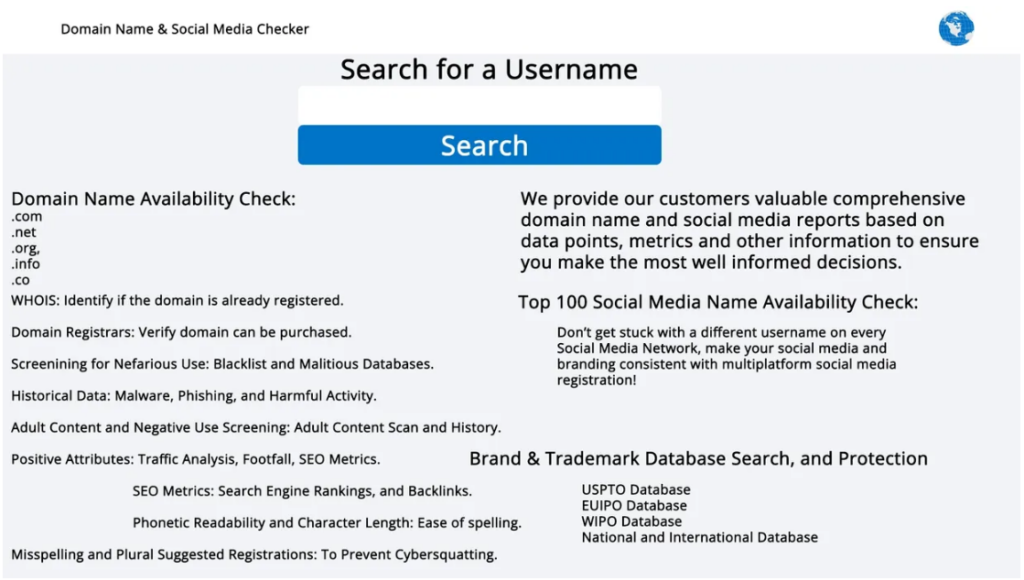
Develop an AI-powered platform that instantly finds, matches, and registers brandable domains and matching social handles across 208+ platforms and six global trademark directories. Frictionless without fragmentation. No price-jacking frontrunners, no guessing. no momentum loss.
Vision:
→ Unified domain + social registration in one click
→ AI-driven name scoring, benchmarking, and competitive insights
→ Security-first identity protection (with patentable tech in stealth)
→ Geo-analytics + dynamic reporting for visibility that scales
→ Human + AI branding support for startups from day one
Treenia doesn’t just match names—we reduce CAC, eliminate friction, and automate what used to take anyone, even agencies, months to do into minutes. With AI-driven phonetic domain name search, instant matching social media multiplatform registration, and seamless optimization, we make branding effortless… So founders can focus on building, not battling availability.
Treenia streamlines brandable domain name search and social media multi-platform registration. Leveraging data points to create infinite new things, new ways to sell, and new ways to distribute.

Treenia Beta

The Paradigm Shift
Treenia is much more than a micro-transformation tool—it’s something users and even registrars could adopt easily. We’re ushering in a fundamental shift to AI search through digital branding. In today’s hypercompetitive online landscape, entrepreneurs and startup businesses simply can’t afford to spend months searching for an available short brandable domain name and then need to verify the domain name for trademark safety, traffic quality, or hidden risks that can damage brand integrity. Then begin the manual search to see if the matching social media handles are available for it. Our AI-powered platform will deliver a rapid, reliable solution that unifies your online identity by eliminating the chaos of lost domains and mismatched social handles. Whether you’re in New York, Silicon Valley, or anywhere else on earth, Treenia empowers entrepreneurs to command their digital presence with precision scalable innovation that delivers an instant online presence.
Treenia Is For:
- First-time founders
- Brand builders
- SaaS startups
- Global entrepreneurs
- Creators and influencers
- Agencies managing identity at scale
- Global Registrars, Registries, and Resellers
- They will value:
- A Freemium Search
- A $5K packaged launch with a 12-24-month lease to own (LTO)
- A $500.00 Startup Value Package
- A $99.00 Builder Package
- Trademark search and services
- Peace of mind Dashboard access
- Premium upsells and à la carte add-ons
- Clean, clear, AI-assisted control
- AI-Powered Precision and Evolution
As society pivots from traditional ISP index search to AI search, many of these tasks can be completed individually. However, not comprehensively. - Treenia is evolving into a powerful ecosystem of:
- AI-Augmented Intelligence
- Human-AI Teaming
- Biometric Cybersecurity
- Geospatial Intelligence
- API-Accessible Agentic Tools
We’re moving beyond SaaS into AaaS (AI Agents as a Service), with a future fit for both human and machine systems, offering Results-as-a-Service, not just software.
Why Now = Market Timing + Technological Inflection + Societal Readiness
Treenia is well-positioned for the “post-outbound AI-flooded” future where everyone can now send tons of cold emails, write SEO blogs, and make LinkedIn videos using AI. It’s cheap and fast. Because of that, inboxes are getting flooded, trust is going down, and people are ignoring outbound messages more than ever. So even if you send 10x more AI-generated messages, you won’t get better results. It just drives up Customer Acquisition Cost (CAC), the cost of getting a new customer.
Building from the bottom-up demand generation and engagement, brand, audience, captive distribution, virality, reputation, network, etc.
- Designing for utility, speed, and instant gratification
- Targeting a problem users already feel
- Structuring virality and social proof into the product
- Avoiding reliance on outbound and paid CAC loops
- Building trust, audience, network, and virality.
Treenia will simply let users discover and share our product naturally. Thus, laying the groundwork foundation for modern branding, biometric cybersecurity, and geospatial intelligence. We transform granular, small-batch consumer insights into enterprise-level D2C and B2B solutions—designed for entrepreneurs, founders, startups, and existing businesses that demand excellence and refuse to settle for second-best.
Purpose-Driven Culture and Commitment
At its core, Treenia is powered by a purpose-driven culture that prioritizes long-term impact over fleeting short-term gains. Our mission is to streamline online branding and empower entrepreneurs through advanced AI solutions that foster real value and sustainable growth. We believe in smart execution, relentless accountability, and a work ethic that is as global as it is personal. Every team member, whether working part-time or full-time, is committed to driving innovation and operational excellence. Treenia’s ethos of mission-first strategy, combined with unwavering grit, makes us the ultimate partner for visionary founders and investors seeking to revolutionize digital identity on a global scale.
Our Work on Treenia and Book in Progress
I’m distilling the hard-earned founder lessons of building a tech startup, fundraising, and digital branding into a book designed to be every entrepreneur’s playbook. This isn’t just another business book—it’s a blueprint for modern entrepreneurship, a tactical founder mode guide built on real-world experience and battle-tested strategies. Inside, you will find a tactical guide on startup execution, branding, funding, and AI-driven growth. I pull back the curtain on what truly works, what fails, and what no one tells you about building a high-impact venture. Starting from the idea. Why? The idea is a solution to a problem that begins in the mind of its solo founder. Be it large or small, a paper clip or a better mousetrap. It all begins as a vision.
As a startup architect, while at the idea stage, I performed due diligence and industry and market research, compiling and organizing this data with use of the Strategyzer business model canvas and the value proposition canvas templates. At Treenia, we’ve successfully validated our concept through a rigorous 3-step market validation process. We began by deeply analyzing the problem space, confirming a clear and growing need for streamlined domain and social handle registration and brand optimization. Our market size analysis revealed a $17.7 million dollar opportunity with underserved user segments ready to adopt bundled solutions. In step three, we mapped out the competitive landscape, uncovering clear white space in automation, instant registration, and AI-driven brand building—gaps our beta exposed. These are gaps our MVP will directly target. With these insights, Treenia is now positioned for funding to accelerate development and bring this game-changing solution to life. A CTO should not focus on building features without small batch testing MVTs to ensure that only the necessary features are built. This approach helps avoid waste and ensures that resources are allocated efficiently.
We had Alex Shapiro, Senior Software Architect (McKinsey & Co., Warner Music), develop our ‘Zero to One’ PoC with these principles. Creating a Pre-MVP Beta for a Market Validation Loop (using Treenia’s AI)—testing domain name and social media ideas with 100 potential users via in person, X, and LinkedIn. Then refining and iterating with mentor Larry Sladewski, VP at NVIDIA, based on feedback. Deploying the agile Lean Startup principles (Eric Ries) and customer discovery methodology of Steve Blank’s Startup Owner’s Manual to validate before building to reduce 29% demand failures and ensure we “build something people want.” Moving to an instant DM lean sprint, tightening the feedback loop to 10 in 12 hours.
Our CRM and email log now has over one hundred, mostly under MNDA, from meetings with various entrepreneurs and SMBs, in almost every industry background, that have asked if this was a problem that they themselves have encountered… And if Treenia’s product were available for sale right now, would you buy it and use it… With overwhelming consensus, all said “YES!”… Of course, many had caveats, such as if it was affordable and reasonably priced, and if they could see it in action first… Paraphrased the most, “That sounds cool!” We also met with Jeff Bedser, Chairman, ICANN Global CS, who introduced us to 2 registrars, ending the meeting with… “How soon can we test it?” Giving us strong B2B signals… We then asked Brad Feld, who co-founded two venture capital firms, Foundry Group and Mobius Venture Capital, and multiple companies, including Techstars. Below are his initial thoughts and feedback…

We Made Something People Need And Want!
The overwhelming results were compelling evidence. Although I am a former C. Inc. founder and CEO of an agency, I understood how to fundamentally organize, manage, and launch a business. However, something just didn’t feel quite right… I wanted to know why previous and current competitors faced challenges doing just this. My first instinct is to learn why. I began by identifying cube farm flops that would have been competitors… Then I took a deep dive into tech startups. Being from the East Coast, USA, co-founder Mike Clark (CMO) and I began in search of a scalable, repeatable model to build a rapid-growth Silicon Valley-style tech startup. We found startup failure rate statistics revealed 70% of startups fail due to team issues or lack of focus (CB Insights, 2024).
Although both of us have in-depth prior experience building and running businesses. We examined these startup problems closely to validate them like an idea, questioning everything we believed and thought we knew to validate and figure out the best way to build a tech startup in today’s rapid AI startup landscape for success. While I worked applying my years of industry due diligence, knowledge, business, marketing, domaining, and website-building contractor experience with creativity. Michael began mapping out our GTM layout.
Michael maps out our growth sprints in 13-week intervals, aligning acquisition, activation, and conversion goals to real-world, weekly performance metrics. Every Monday, he leads a quick review to hit our weekly targets for free tool usage, lead generation, and paid conversions. What pace toward monthly projections? How we will track the data, identify friction points, and adapt messaging or channel focus in real time. Michael also owns the DRI (Directly Responsible Individual) system for marketing and GTM. He leads with full accountability—no handholding, no silos. Every Friday, we stop all external meetings, as no good news comes from external meetings on Friday… Just a pro tip) and he drives our 60-minute sync where scorecards are reviewed, blockers addressed, and execution priorities realigned.
This rhythm keeps Treenia lean, focused, and aggressively adaptive, even as we scale. Michael’s approach turns clarity into speed and strategy into measurable traction. Where my ethos is seen from the lens at the bottom of an educational value drip funnel. Aiming for 2K-5K freemium users and 250 paid user traction to demonstrate we are focused on creating “a product people love!” Positioning us for options to bypass Angel rounds… While also watching how the new tectonic shift of venture capital will shake out as VC firms are becoming RIAs that are rolling up private equity giants. To avoid fundraising for marketing with WOM community virality at scale and carve a deep enough wedge in the marketplace will need serious consideration. But why chase consumer SaaS when white label B2B is an option???… So, the objective is not to market D2C but merely to prove it as D2C and then license it as a white label for B2B in the roadmap…
We are currently in the process of refining our Proof of Concept (POC) and exploring opportunities to scale. We’re looking for strategic partners who share our passion for disrupting the digital branding space and can bring valuable insights and expertise to help guide us to the next stage of growth. At Treenia, our ‘Ganas’ recruitment style is directly inspired by Stand and Deliver and the Marshmallow Experiment’s focus on grit, with delayed gratification to counter burnout (16%) and team issues, aligning with 80% of successful founders citing expertise. Together with a flexible, structured cash-flow budget allocation of 15–19% per department. Making VC funding optional for scalability addresses the 29% funding failure rate and 42% scaling risks. While it insists on onboarding only those co-founders who are not only experts in their domains but are also visionary contributors with a relentless entrepreneurial spirit. To achieve velocity, which is not just a measure of speed but a multifaceted indicator of the progress and efficiency of startup teams.
I’ve seen firsthand how the startup landscape has shifted in the AI era, where a solopreneur CTO can 10X their outbound output but also faces 10X the responsibilities. Ahmad Nassri’s “Startup CTO Cheat Sheet” highlights this burden: a modern CTO must juggle analytics ownership, software engineering, customer metrics, security, and more, all while navigating conflicting roles as Chief Marketing, Digital, Technology, Security, and Information Officer. For a solopreneur CTO, this means wearing all hats—from coding and product development to strategic vision and team leadership—often leading to burnout by year four, as Ahmad Nassri’s growth cycle shows the role evolving from “The Maker” (<5 engineers, $1M ARR) to “The Executive” (>50 engineers, $20M+ ARR). I experienced this myself as a non-technical solo founder using AI, struggling to keep up before realizing the pitfalls of fractional CTOs, who, as Ahmad Nassri notes, can leave projects unfinished and misaligned with a founder’s vision, risking clawbacks from VCs if undisclosed, as I’ve witnessed happen.
Startup Resources and Playbooks
In contrast, we developed an iterative, robust hybrid, indie-hacker-vibe founder(s) accord startup framework we call “AFAT” that demands co-founder strategic alignment. By following this approach, you maximally de-risk founder onboarding, avoid future negotiation ambushes, and create a foundation for healthy, aligned, and committed co-creation—de-risking the startup (from the very beginning before just filing to get our certificate of incorporation (COI) and start a business). Think of it as a draft of a blueprint prenup for a business partner(s). A simple agreement can save you years of pain—here’s what to include:
- Agreement Overview
• Sets roles, expectations & equity splits
• Prevents future disputes
• Works even pre-incorporation - Who’s Involved
• All co-founders sign
• Must include names, roles, and addresses
• Valid even before the legal entity is formed - Key Clauses to Include
• Roles & Responsibilities
• Equity Distribution
• Vesting Schedule
• IP Rights
• Time Commitment - Business Protections
• NDA + Confidentiality
• Non-Compete & Non-Solicit
• Dispute resolution plan
• Expense reimbursement - Exit & Death Planning
• Voluntary or forced exits
• What if someone dies or disappears?
• Share transfer protocol - Money & Funding Terms
• How and when you get paid
• Future funding expectations
• Amendment process - Legal Wrap-Up
• Jurisdiction & governing law
• Termination & warranties
• Official execution date
Your Startup Is Your Baby; Treat the Founders Agreement Like Its Birth Certificate.
A Founders Agreement defines each founder’s roles and responsibilities, equity ownership, intellectual property (IP) contributions, decision-making process, vesting schedules, and exit protocols to hand off to a lawyer who will then create a formal legal Founders Agreement and a Shareholder Agreement (SHA) with an Articles of Association (AOA) (sometimes called a Certificate of Incorporation (COI), Bylaws, or Constitution, depending on jurisdiction).
A Fatal Startup Founder Mistake Is To Think These Legal Documents Are The Same… They are not!
An SHA Covers:
Both are legal documents that define how your company is run, but they operate at different levels. A Shareholder’s Agreement is entered after incorporation, once shares are issued. It governs the relationship between shareholders, which may include founders, investors, employees with ESOPs (Employee Stock Ownership Plans), and others. After the company has been incorporated and shares have been issued. The SHA is more about ownership, control, and governance. It defines how shares can be sold, transferred, or inherited; how board decisions are taken; and what rights minority shareholders have.
The AFAT Startup Framework offers unique insights for today’s lean team startup landscape, where 90% fail globally—20% in two years, 45% in five, and 65% in ten (D’Souza, 2025). The AFAT Hybrid One-Five-Founder Model with 10:1 dual-class shares and 100% ROTI (Return-On-Time Investment) purpose-driven commitment culture tackles the 23% team failure rate by ensuring aligned, execution-driven founders.
The AFAT is a new startup framework needed for a new era of AI startups. Here’s WHY.
It is now 2025, the SaaS hustle-maker/indie hacker era with an AI feature is struggling, and it’s largely because VC-backed solo founders who don’t transition to a purpose-driven culture will likely fail. The next 18 months will filter out “hustle for hustle’s sake” AI startups. Those who don’t evolve into purpose-driven, customer-centric companies solving real-world meaningful problems will either pivot or die. What is rising: a new wave of lean, agile, and mission-driven teams that know how to execute with clarity. While in 2025 we may also see the first 1-founder-human and all-AI-co-founder-led startup with 5 roles:
—That is it. NO EMPLOYEES!
- AI Has Flattened the Playing Field
The indie hacker model thrived when unique engineering skills gave founders an edge. Now, AI enables non-technical founders to ship products faster, reducing the technical moat and making distribution, branding, and customer alignment far more critical. Without a clear purpose and differentiated vision, many solo-built products are just features, not companies. - Funding Now Favors Sustainable Business Models
Investors are no longer throwing money at “growth at all costs.” They’re backing teams with strong execution, customer alignment, and real business models. Solo founders grinding without a clear, purpose-driven direction (beyond just launching products) will struggle to gain traction and funding. - The Death of the Solo “Grind to Exit” Model
Many past indie success stories were built on low-cost acquisition channels (organic SEO, virality, early social media arbitrage, etc.) that are now saturated. Building a defensible company requires a strong team and culture, not just a single founder cranking out features in isolation. - Customer-Led Growth Is Beating Feature-Led Growth
Hustle culture was obsessed with shipping fast and iterating. But now, customer discovery, trust, and brand affinity drive adoption more than ever. Companies that aren’t deeply aligned with their customers’ evolving needs will fade—especially those led by solo founders stuck in a build-first mindset. - Purpose-Driven Cultures Outlast Short-Term Hustlers
Startups that prioritize a mission, purpose-driven commitment culture, and long-term vision attract better teams, retain customers, and survive downturns. VC-backed solo founders who lack this foundation will burn out, fail to hire effectively, and ultimately struggle to adapt as market conditions tighten.
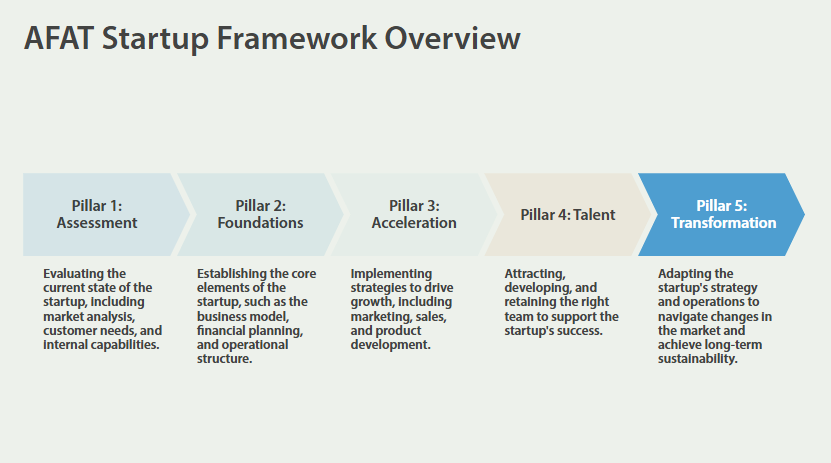
The Adaptive Founder AI Triangle (AFAT) Startup Framework
Unveiling the Path to Startup Success: Why Team Dynamics Matter Most in 2025
I’ve always believed that who you build with defines your startup’s destiny—a truth echoed in Stanford University Professor Ilya Strebulaev’s Unicorn Report. Surveying over 500 venture capitalists, the report reveals that team dynamics are the top failure factor for startups, with 55% of VCs citing it as critical, rising to 60% in IT and 48% in healthcare. This aligns with my AFAT Startup Framework’s core pillar: a purpose-driven, execution-focused team culture, ensuring alignment and grit to drive scalable innovation.
Strebulaev’s data shows startups with 3–4 founders are 74% more likely to become unicorns, while solo founders falter 38% more—underscoring Treenia’s Hybrid One-Five Founders Model for AI-driven startups in Silicon Valley and beyond. Venture capital-backed failures often stem from misaligned teams, not just tech or timing (only 8–9% of VCs cite these). Embrace our Ganas recruitment and 100% ROTI AFAT ethos to transform your entrepreneurial journey for global impact.
The startup world is riddled with outdated playbooks and bad habits. Far too many founders face a false choice: either bootstrap and struggle endlessly or chase angel investors and venture capital that relinquish control. High-burn, high-risk startups, even those that are VC-backed, often burn out by year four because they’re built on misaligned incentives, passive founders, and premature scaling.
Today a growing wave of startups begins with a non-technical solo founder and AI. I was once in that position—launching as a non-technical solo founder using AI before adopting a purpose-driven culture.
WHY?
The AFAT isn’t merely about launching a business with a minimum viable product… it’s about constructing a company built for long-term success. While many startups rush to build-measure-learn using Lean Startup methodology, AFAT begins with a commitment-first, execution-driven blueprint that forces founders to think beyond mere survival. In an era where solo AI founder startups based solely on feature novelty are bound to fail, this framework provides a strategic north star… not a rigid destination. We encourage ongoing refinement, with deep attention to risk management, financial rigor, and the application of real-world case studies. AFAT is a compass, not a map, guiding founders toward building enduring, scalable companies.
AFAT Hybrid Startup Framework: Five Key Pillars
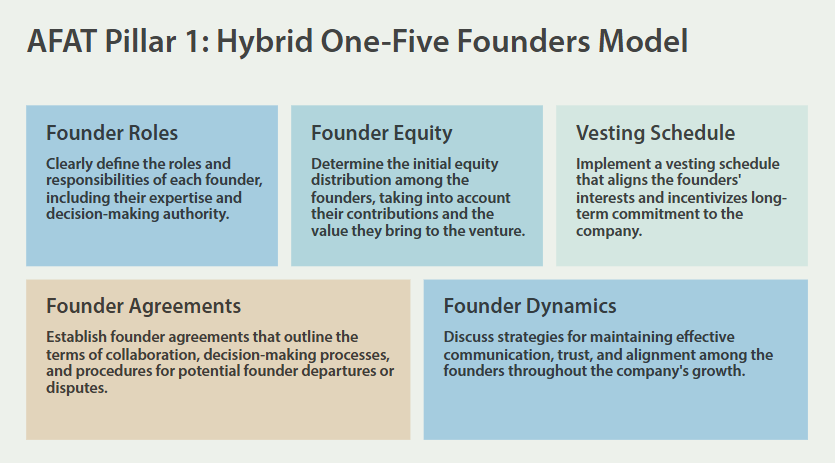
1. The AFAT Hybrid One-Five Founders Model
Today, with AI, lean startups begin with a solo founder and will need to grow from 1–3 core roles (e.g., visionary, tech, and brand) based on stage, with the use of artificial intelligence (AI) agents, chatbots, and machine learning (ML) automation for workflows, legal, finance, or other tasks. At Treenia we utilize Founder Advisor FAST Agreements and Specialist EASE Agreements for fractional equity (0.5–2%). These are used to compensate advisors, specialists, or part-time contributors until onboarding a CLO and CFO co-founder, growing to a full five-co-founder team when justified.
Roles: CEO, CTO, CMO, CLO, CFO
- Each founder has vision, grit, a clearly defined role, deep domain expertise, and accountability.
- Dual-class shares (10:1) ensure that strategic control remains in the hands of active, committed founders.
- 100% ROTI (Return on Time Investment) purpose-driven commitment culture.
- There are no free rides. Equity isn’t simply granted by tenure—it’s earned through execution and results.
- 4-year vesting with a 1-year zero-out cliff (ensuring any equity not fully vested returns to the startup).
- 1/48th monthly for the remaining 36 months until full 4-year vesting.
- Secondaries post-QSBS, ensuring liquidity that aligns with each founder’s contribution over time.
2. Flexible Structured Cashflow Departmental Size Allocation-Driven Performance
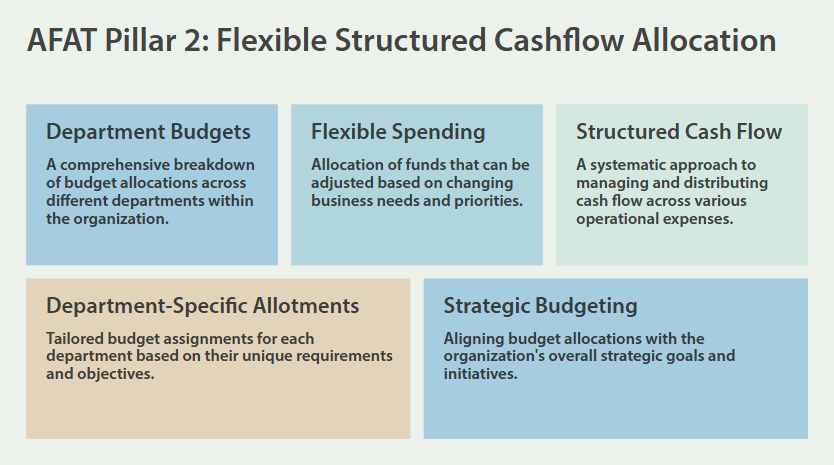
We examined startup frameworks and the BI Triangle’s eight integrity business components structure of Robert Kiyosaki and Buckminster Fuller. With a focus on mission, team, leadership, product, legal, systems, communications, and cash flow. To find a flexible way to allocate funds as a guide to ensure each department can be funded to scale, while thinking through headcount, forecasted expenditures, and SG&A. To allow smaller niche startup teams to allocate budgets as they onboard to keep a flexible budget while bootstrapping to pay for CLO and CFO services as needed and delay recruiting the CLO and CFO cofounders to suppress costs.
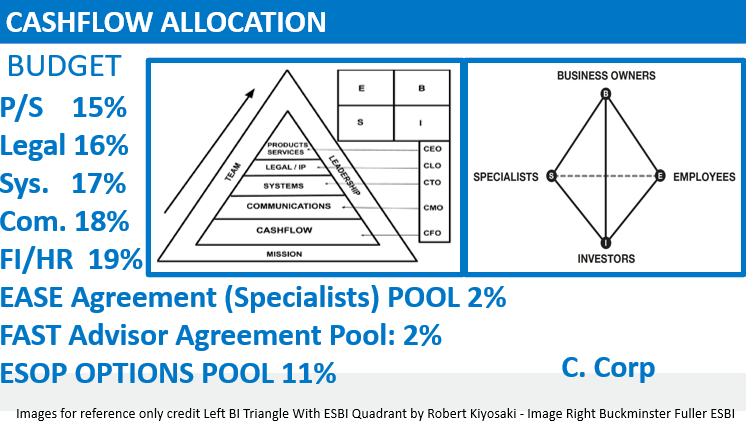
- 15% for the CEO (Strategy, Vision, Growth)
- 16% for the CLO (Legal, IP, Compliance—be safe rather than sorry)
- 17% for the CTO (Technology & AI Development—usually leaner due to AI)
- 18% for the CMO (Marketing & Brand Growth – Teams, and teams need funding and budget)
- 19% for the CFO (Financial Strategy, HR, Capital Allocation—the largest department)
- 15% Options Pool (Employees, Advisors, Specialists)
3. Scalability & Fundraising Flexibility
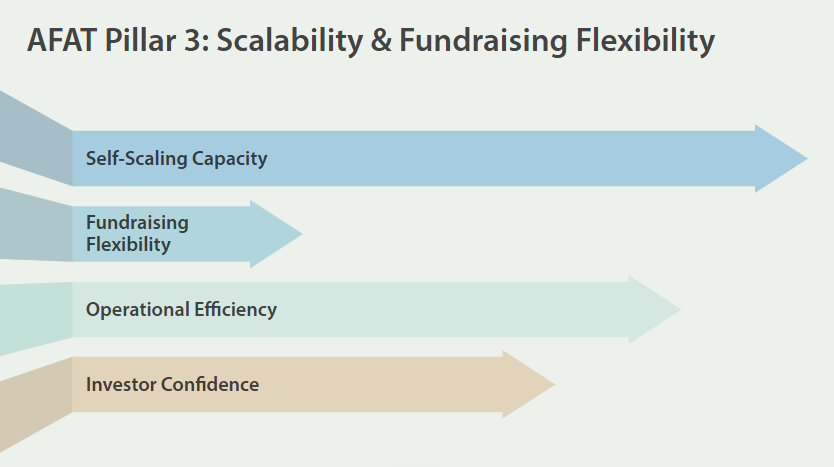
- Raising angel investors and venture capital from VC firms Investing in AI is an option—not a necessity—allowing the startup to scale on its own terms.
- The AFAT framework forces startups to plan for the future pre-launch, post MVP.
- It demands every co-founder be strategically aligned and fully committed to the company’s long-term vision (a co-founder may start part-time while also employed elsewhere until sustainable, at which time they must become a full-time co-founder).
- Note: A VC will not fund a startup with a co-founder that is not fully committed and dedicated full-time. Thus, as a startup, you build quietly in the moonlight. Allowing all members to work anywhere and make money any way they have to until the startup salary for each co-founder is fully supported either by revenue or by investment… At which time all co-founders will then turn the desk around… Switching their mindset away from working for a paycheck to becoming an owner. Where the objective then becomes building a company, where your role is recruiting, hiring, and training management in long-term workflow, and you could eventually leave, still get paid, and return two years later to find it better off than when you left it!
- There’s no room for passive equity or dead weight—only true builders who execute.
4. Recruitment & Culture
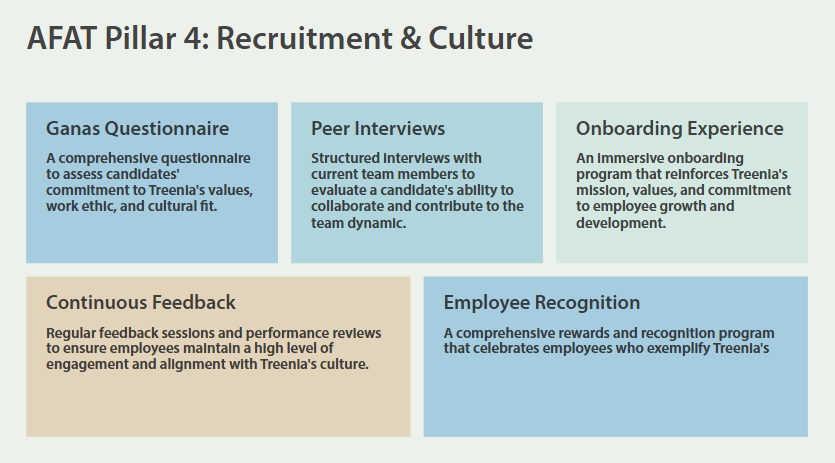
- A Purpose-Driven Commitment Culture is The True Differentiator
Traditional lean startup methodologies focus solely on launching an MVP to validate an idea. In contrast, our commitment culture goes deeper—it’s about who you choose to build your company with and how that team envisions the future, adopting “Zero to One” innovative first principles thinking, taught by Peter Thiel at Stanford University.
Treenia’s Talent Recruitment: Driven by Ganas
At Treenia, our recruitment process mirrors the essence of the classic film Stand and Deliver, where the focus is on passion, drive, and the gritty determination to succeed against extreme challenges of adversity—qualities defined as “Ganas ~ Desire”… Treenia is living the AFAT principles, proving that commitment and execution can redefine the startup playbook. Join us in shaping this future.
When we seek talent, we’re not just looking for skills or qualifications, but for individuals who possess that relentless drive to overcome obstacles and make an impact. Just as the students in Stand and Deliver rise above adversity with grit and focus, demonstrating a willingness to learn calculus. By becoming a team cohort held to extreme accountability, they accomplished together what the status quo believed was impossible, and that is the power of teamwork. We want team members who are scrappy and ready to take ownership, make bold decisions, and contribute to Treenia’s mission and vision of reshaping the future of digital branding.
It’s all about heart and hustle.
We look beyond resumes to uncover the inner spark that propels individuals to overcome challenges and excel. Much like Jaime Escalante recognized the potential in his students despite their humble beginnings, our rigorous interview process identifies candidates who display an endless willingness to learn, are coachable, and display relentless determination, creativity, and a hunger for success. This approach ensures that our team is built on diverse, resilient, and motivated talent committed to transforming digital branding and pioneering innovation.
Questions we ask everyone…
- What do you love to do so much that you would do it for free?
- Tell me about a time you made a decision few people agreed with.
- What excites you about Treenia’s mission of streamlining online branding and social media integration?
- What’s the most important lesson you’ve learned in your career, and how has it shaped your approach to work?
- What unique perspectives or skills do you bring to a team, and how do you think they would contribute to Treenia?
- If you could improve one aspect of Treenia’s user experience, what would it be, and why?
- Where do you see the future of online branding, and how would you help Treenia stay ahead?
We select only those visionary contributors who bring deep domain expertise and an unwavering entrepreneurial mindset. Thus, we want founders and team members who are ready to take ownership and contribute to long-term success and gel as a team through our customer development methodology regardless of whether they start part-time or full-time—it’s about making every moment count. Part-time co-founders are welcome, but dedication and consistent contribution are non-negotiable.
- We are a tightly knit elite team.
- We are not transactional clock-watchers.
- We are equally obsessed, talented, and aligned.
Every member commits to 1% more daily, compounding into 1–2% weekly wins (6–12% monthly)—be it one email, one task, or one sales call. Although we are human, we hold each other to strict actionable innovation accounting, while balanced and flexible with empathy… We don’t hesitate to exit the wrong people from the bus because we’re drivers, not passengers. Objective: 20% MOM growth rate at PMF for 9X YOY!
Our culture ensures:
- Employee Loyalty & Retention
- Consistent Performance & Growth
- Long-Term Stability
5. ESOP (Employee Stock Ownership Plan) 100% ROTI (Return-On-Time Investment) Purpose-Driven Commitment Culture Performance-Based Founders Accord
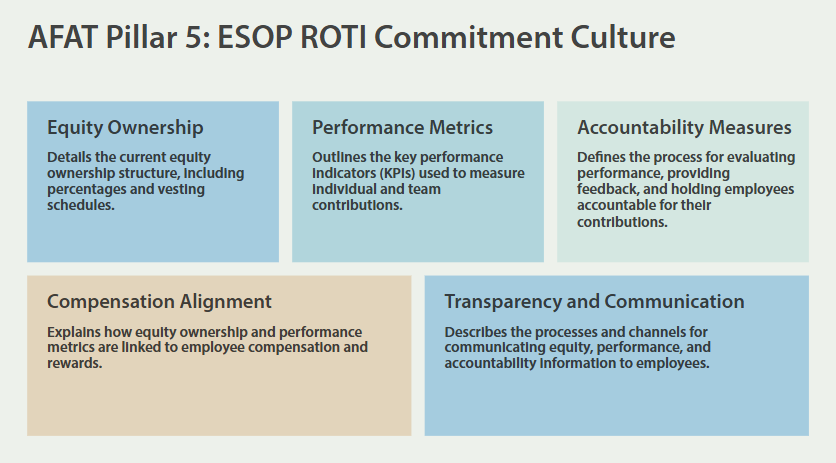
We began by drafting a Founders Accord; it is a template first introduced by McCormick & O’Brien, LLP, (as a temporary draft of a co-founder’s agreement for use while recruiting our co-founders with our temporary entity prior to COI (some call this Stealth Mode)), ensuring we recruited the right co-founder team before we filed a certificate of incorporation (COI), which starts the startup velocity clock in front of investors. In short, it bought us time to think through, recruit, build trust, and gel together while holding each other to accountability by tracking performance (with the ability to root out passive founders) without sacrificing equity.
“We Are Founders, Not Attorneys, and This Is Not Legal Advice.”
The AFAT Startup Framework below is our boilerplate.
For this we adopted a temporary document used in place of a formal Founders Agreement (that has a much more stringent framework and usually requires final drafting by a startup business attorney). In the beginning… It is wise that everyone, even co-founders, sign an NDA with an IP clause that anything made, discussed, or shared belongs to the entity owned by X…………………. a slated entity to be founded as X…………………………., Inc.
Each founder irrevocably assigns all rights, title, and interest in any intellectual property (IP) created in connection with the company to [Startup Name]. This includes but is not limited to patents, trademarks, copyrights, and trade secrets. Founders shall not engage in, advise, or fund a competing business for a period of [X months] post-departure. Thus, all intellectual property (IP), including ideas, designs, code, processes, and trade secrets, whether created before or after incorporation, shall be deemed assigned to the company if utilized in any form for company-related purposes. Any IP carve-out must be pre-approved by the Board, with a signed agreement specifying ownership.
- All IP created—past, present, and future—by any founder is owned by the company, not individuals.
- No carve-outs for pre-existing work unless explicitly approved by the company (prevents disputes about “prior inventions”).
- Non-compete & non-solicitation clauses should last at least 36 months post-exit (subject to local legal restrictions).
(As a rule of thumb, investors will not sign an NDA) … Their primary interest is in you, and they are confident you are not only a team of experts building a startup. You are going to do what you say you can do.
PRO TIP: Immediately after the NDA is signed, take notes in each meeting about what is discussed with candidates and co-founders, and always mention anything that is deemed a trade secret, potential IP, or IP in a follow-up email for the LOG. When you host a meeting or share messages about the project… Always copy the entire thread with the date and time stamp into the meeting scheduler to close the loop. That way there is no question of who knew what, when, and what others know undeniably.
- Defined Roles and Responsibilities:
It outlines each founder’s specific roles and decision-making authority, helping to prevent misunderstandings and ensuring everyone shares a common vision for the company. - Structured Conflict Resolution:
Establishes clear procedures addressing disagreements, reducing the likelihood of prolonged disputes. - Clear Equity Distribution:
The document details each founder’s ownership stake, minimizing ambiguities and helping align expectations regarding contributions and rewards. - Protective Provisions:
It includes measures to safeguard the interests of both the company and its founders, particularly in situations where a founder may leave or be unable to continue their role—an important consideration during the early, vulnerable stages of a startup. - Intellectual Property Assignment:
The agreement clarifies the ownership of intellectual property (IP), which is critical in maintaining a competitive edge and ensuring that innovative contributions are properly recognized.
A. Equity
Our equity distribution follows industry-standard splits from over 7,000 startups (via Carta) to keep our cap table investor-friendly. The following is drafted into the Founder’s Accord and Founder’s Agreement prior to COI. Equity is allocated based on responsibilities, market norms, and contribution levels, subject to board approval.

Having all of this formula locked into the founder’s agreement ensures all founders—co-founders—understand the allocations will change as each member is onboarded during growth, not based on greed or perceived value, yet based on what works. In today’s startup environment, team sizes are shrinking. While watching the growth of the maker era indie hacker builds and ships, startup amateur CTOs demand higher equity stakes… Sometimes demanding an equal split. However, that flat equity structure only works for those who seek a quick exit… Not an enduring business… Here’s why!
The equity splits in the Carta chart total only 95% (not 100%).
The 5% difference you’re seeing is intentional and very common:
📌 What the 95% Represents
The equity splits shown reflect the median founder allocations before any fundraising but after reserving space for other critical needs:
The Missing 5% Usually Goes To:
– Future early hires: 2–3%
– Advisor/board equity: 1–2%
– Flexibility buffer: 1–2%
So even pre-COI, savvy cap table planning leaves room for:
- ESOP/Options Pool
- Advisory Shares
- Future co-founders or “earned-in” contributors
- External talent acquisition
- Equity-based incentive offers (FAST, SAFE triggers, etc.)
Carta’s Chart Reflects Reality of Cap Table Design
This is not a mistake; it’s best practice.
If you issued 100% to founders immediately, you’d have no flexibility without creating dilution the moment you needed to bring someone on. That would slow you down or create friction (and risk QSBS resets).
However, many of these Indie Hacker-style startups are failing instead of scaling due to greed. Where the ideology is not focused on building and launching a successful startup… It’s focused on launching a mediocre product and hoping for an acquisition exit. Instead, we are passionate founders focused on building an investable, repeatable, and scalable Silicon Valley-style rapid-growth tech startup that solves real-world problems with deep, meaningful, resonating impact… built for long-range X2, X2, X3, X3, and X10 results.
- 1-Founder Team: CEO holds 100%
- 2-Founder Team: CEO 55%, Partner 45%
- 3-Founder Team: CEO 47%, CMO 33%, CTO 17%
- 4-Founder Team: CEO 40%, CMO 27%, CTO 18%, CFO 10%
- 5-Founder Team: CEO 35%, CMO 22%, CTO 17%, CFO 12%, CLO 9%
WHY?
It is important to note: The business model is a pyramid structure that forces founders to determine equity distribution by department size and head counts as you move forward. Thus, reducing friction and arguments later about equity splits, department sizes, time, and responsibility. The key is business success, not personal gratification.
B. Terms
- Performance Accountability (No Free Rides). Each member commits xyz time to the entity progressively. (Eg) If a co-founder fails to meet their defined responsibilities for [X] consecutive months or materially underperforms against agreed-upon deliverables, the remaining founders may initiate a buyout of their vested shares at a pre-determined fair market value or nominal price. For-Cause Removal Clause allowing founders to be removed without equity vesting acceleration if they fail to perform. Whereas A founder may be removed for failure to meet key deliverables over [X] consecutive months, breach of fiduciary duty, misconduct, or other material violations. Removal requires a majority vote of the Board, excluding the affected founder. Unvested shares return to the equity pool, while vested shares may be repurchased at either (a) fair market value (if a Good Leaver) or (b) nominal value (if a Bad Leaver based on misconduct, fraud, or negligence).
- Shared = Dilution
- Purchase 85% of 10M Dual-Class Shares filed with a PAR Value at COI of $0.00001. Prior to Fundraising.
- Delaware C. Corporation – Certificate of Incorporation (COI)
- File Section 83(b), a provision under the Internal Revenue Code (IRC) that gives startup founders and employees the option to pay taxes on the fair market value of their restricted stock at the time it is granted. If you do not file an 83(b) election within 30 days of issue, your stock will be taxed on its fair market value at the time it vests. Must Be Filed Within 30 Days of COI Before Any Fundraising.
- 15% Equity Pool
-11% for Employee Options (Evergreen Pool)
-2% for EASE Agreement (Specialist Contributions) Example: Specialist to provide something of need… Pre-seed–pre-money–startup value at $6M for 0.25% equity in exchange for service needs to equal $15,000.00.
-2% for FAST Agreement Advisors (with a cost for a 0.25% equity—make sure they pay for it and have skin in the game). Also be sure this is tied to a commitment for time and not dead weight. - All founders have a 4-year vesting schedule with reverse vesting beginning with a 1-year zero-out cliff followed by 1/48th per month for 36 months. Bad Leaver vs. Good Leaver Clause Buyback Provision ensuring that if a founder leaves voluntarily or is fired for misconduct, their equity is repurchased at nominal value rather than fair market value.
- 10:1 Voting Power Dual-Class Shares—common for founders & preferred for investors, ensuring founder control.
- Provisions for Secondaries Post-QSBS (Qualified Small Business Stock) and Acceleration if Acquired Lock-Up Period—No founder may engage in secondary sales of shares prior to Series A without board approval. After Series A, founders may sell up to [X]% per year post-QSBS qualification, ensuring liquidity without destabilizing control. Any exceptions must be pre-approved in writing by the Board.
- All out-of-pocket founder-provided resources to the startup founders’ out-of-pocket expenses shall be treated as either:
- (a) Reimbursable Loans, repaid post-funding when the company reaches [$X revenue or Series X funding], OR
- (b) Convertible Notes, allowing conversion into equity at the next fundraising round’s valuation, subject to Board approval…
- In the beginning expenses are borne and shared by all founding members’ contributions as fairly as possible… This includes maintenance, ongoing subscriptions, and other needs.
- The CEO secures 1 board seat plus an additional vote to resolve disagreements until Series A closes. The founder must be willing to step aside, if necessary, for a new CEO. However, he still maintains a board seat with full compensation, immediate acceleration, and secondaries for all shares. If the CEO’s leadership is deemed ineffective by a supermajority Board vote (e.g., 75%+), they may be replaced. The CEO retains board representation and immediate acceleration of their vested shares but must transition to a strategic advisory role unless otherwise agreed.
Conclusion: The Future of Startup Success
The AFAT is for founders who build, execute, and scale without falling prey to traditional startup failures. Fractional hires will never get rich by merely renting their time; real wealth comes from owning equity. We welcome part-time co-founders, but dedication and consistent contribution are non-negotiable.
- If you’re an investor, founder, or operator, it’s time to rethink how startups are built. The next generation of high-impact companies will be crafted by those who master commitment, alignment, and execution… For maximum DCF (discounted cash flows) valuation, based on value, structure, and risk.
Being a great startup contract crafter of your co-founder agreement is crucial for setting clear expectations and preventing disputes as your startup grows. Here’s what you should include:
1. Basic Information
- Company Name & Purpose: Define the startup’s mission and business activities.
- Co-Founders’ Details: Full legal names, roles, and responsibilities of each co-founder.
2. Equity Ownership & Vesting
- Equity Split: Percentage of ownership each co-founder gets.
- Vesting Schedule: Typically, a 4-year vesting schedule with a 1-year cliff (i.e., if a co-founder leaves before one year, they get nothing). This prevents someone from walking away early with a large stake.
- Acceleration Clauses: Conditions under which vesting accelerates (e.g., acquisition, firing without cause).
3. Roles & Responsibilities
- Decision-Making Process: How key business decisions will be made (e.g., unanimous vote, majority vote).
- Duties & Time Commitment: What is expected from each co-founder in terms of work contribution and time.
4. Intellectual Property (IP) & Confidentiality
- IP Assignment: All IP created by the co-founders related to the startup belongs to the company, not the individuals.
- Non-Disclosure Agreement (NDA): Co-founders must keep company information confidential.
5. Compensation & Expenses
- Salaries (if any): Whether co-founders will be paid and under what conditions.
- Expense Reimbursement: What business expenses the company will cover.
6. Decision-Making & Dispute Resolution
- Voting Rights: How voting power is distributed (e.g., proportional to equity, equal votes per founder).
- Tiebreaker Mechanism: What happens in case of a deadlock (e.g., board intervention, external advisor)?.
- Dispute Resolution: Mediation, arbitration, or jurisdiction for legal disputes.
7. Founder Exit & Termination
- Voluntary Exit: What happens if a co-founder wants to leave?.
- Involuntary Removal: Conditions under which a co-founder can be fired (e.g., misconduct, underperformance).
- Buyout Provisions: How the company or remaining founders can buy back an exiting co-founder’s shares.
8. Non-Compete & Non-Solicitation
- Non-Compete Clause: Prevents co-founders from starting or joining competing businesses (may be limited by law in some regions).
- Non-Solicitation Clause: Restricts poaching employees, customers, or investors for a certain period after leaving.
9. Governing Law & Jurisdiction
- Specifies which country’s or state’s laws apply to the agreement. For example, Delaware law is common for US startups.
Now get to work—time is money—the more you waste, the more you lose!
Take the time to craft your Founder’s Accord with your co-founders as a team, and review each step carefully to avoid any misunderstandings, and work through them amicably. Treat it as if it were your formal Founder’s Agreement, and when you are ready to have a lawyer draft your Founder’s Agreement and file your COI, cut the equity pie, and launch… You have already accomplished something great together that most others fail at before they start up. As for performance… Be mindful and make a log… Time is everyone’s most precious asset, and sacrifice—be sure to be human. However, silence is a tell-tale sign of abuse and often begins by someone not showing up late or not at all for either scheduled meetings or an important meeting they are required to attend.
Blog—Thoughts on Innovation and Leaders
Ideas That Shape the Future
Every post here is a step toward sharing the knowledge I’ve gained through years of hands-on work in the startup ecosystem. From AI tools to funding strategies, this space will cover everything from vision-driven leadership to operational efficiency.
From “educo” (financial education not taught in schools), I learned from my grandfather… I used it here to create the one-page business plan for a startup service contractor as a business model framework and playbook below… PAY YOURSELF NOT TO WORK!
At age 18 I created my first business… At Bricks N’ Mortar, the high school superintendent was my first customer. I then hired my close friend and classmate as my first employee.
The “NEWCO” Startup Template Framework and playbook
This contractor business model and “NEWCO” playbook are valuable for both tech and non-tech entrepreneurs. Below is a high-profit contractor business model.
Contractor $5,200 Job
- Materials cost = $2600.00
- Labor cost = $2600.00
You net $3,880.00 profit.
By hiring 1099 cash crews and working smart. One skilled, one unskilled = 2 days, then repeat. Fuel, food, tools, and insurance are baked into every project. Use your home office, vehicle, and phone for tax write-offs. Track every dollar, pay yourself first, and scale with 3 jobs/week = $11.6K/month. Built lean for growth.

Hire Great People Focused On Excellence!
Education
Thomas Edison State University PTC GPA: 3.9
- Microsoft AI Startup Certified and Trophy Awarded: Build an Early-Stage Startup (October 2023)
- Microsoft Startup Fundamentals (September 2022)
- Microsoft Startup Fundraising (September 2023)
- Khan Academy Business Administration and Management, General (January 2007)
Awards
- Top 100 Advertising Experts to Follow on Twitter 2014 by Evan Carmichael Advertising NY.
- Top 70 Social Media Experts to Follow on Twitter 2013 by Evan Carmichael Advertising NY.
- Top 5% Most Viewed Profile on LinkedIn 2012, by SVP, Deep Nishar
Recommendations for Ronald Simons
Recommendation:
“Ronald is a brilliant marketer, leveraging both traditional and envelope-pushing tools to benefit his clients. From the most tangible forms of marketing—items you can hold in your hand like coffee cups—to cutting-edge digital like Cover Photo Magic, Ronald embraces them all. He is a master at connecting the right people with the right strategies for the maximum benefit to all.” June 21, 2012
Irene Silber, Consultant
http://www.linkedin.com/in/irenesilber
Recommendation:
“Ronald is a very determined entrepreneur with a successful track record of accomplishments. In the years that I have known Ronald, he has been energetic, detail-oriented, and passionate about the work he does and the people he interacts with on a regular basis. Ronald is successful at every aspect of running a business. He is determined to succeed at whatever he puts his mind to!” December 28, 2011
John M. Kalinowski, Strategic Marketing Specialist, JK Marketing Specialist, LLC
http://www.jkmarketingspecialists.com/
Recommendation:
“Ronald’s driven persistence and ability to adapt to marketplace changes make him a successful entrepreneur. With vision, intelligence, and intuitiveness, Ronald developed the Globe Icons business model, which will revolutionize the advertising/marketing industry. He is honest, hardworking, and professional. I highly recommend Ronald Simons.” August 15, 2011
Stephen H. Joseph, Esq., Senior Partner, Stephen H. Joseph Attorney-at-Law, PC
http://www.stephenhjoseph.com/
💼 Trusted by Industry Leaders
I’ve had the privilege of collaborating with, learning from, and being advised by some of the most accomplished minds in AI, cybersecurity, branding, and venture capital, including:
- Stephen Joseph, Esq., Angel Investor
- Mike Culliney, VP, Unilever
- Robert Shalayda, VP, NOKIA, Wharton Valuation Associates
- Larry Sladewski, VP, NVIDIA Growth Graphic (Retired)
- Alex Shapiro, Senior Software Architect, McKinsey & Co., Warner Music Group
- Mike Kaczmarek, VP, VeriSign
- Jeff Bedser, ICANN Global Cybersecurity Chair
Connect With Me, and Let’s Create Something Groundbreaking.
Ready to disrupt an industry? Whether you’re an investor, founder, or strategist, let’s connect and explore new frontiers in AI, branding, and digital identity. Reach out—I’d love to collaborate on what’s next.
What’s your experience with hustle culture—has it worked for you, or do you see it fading too?
Or after AFAT, which pillar resonates most with your startup journey?
Empowering entrepreneurs to make their mark—one domain, one profile, one business at a time.
X @RonaldSimons – LinkedIn Ronald Simons
#ContractorHustle #ServiceBusiness #1099Workforce #HomeImprovementStartup #LandscapingBusiness #RemodelLife #RonaldSimons #ConstructionCashFlow #StartupBlueprint

©Ronald Simons 1993-2025 all rights reserved